
Joint Disorders / Sandhivata
Ayurveda Treatment for Osteoarthritis
Worn cartilage does not grow back. But pain, stiffness and the slow loss of function are all treatable — and for many patients, that is the difference between managing a knee and replacing one.
40+ years
Led by Prof. Dr. G. G. Gangadharan
Yelahanka
North Bengaluru, Judicial Layout
Basti-Led
Vata’s primary classical therapy
What is osteoarthritis?
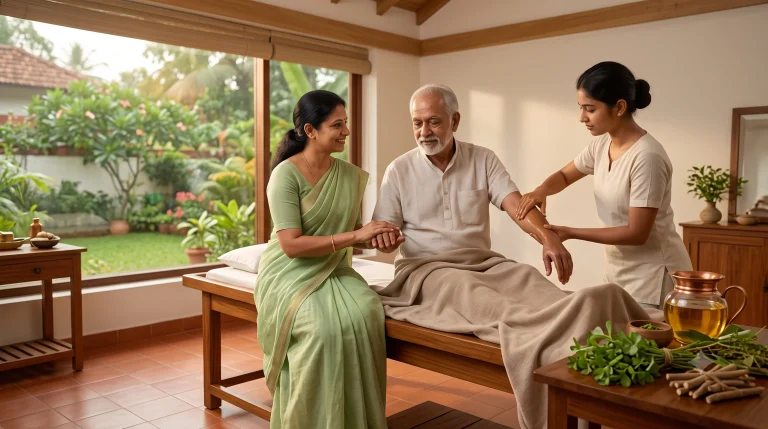
Osteoarthritis is the gradual wearing of the cartilage that cushions a joint. As that layer thins, bone surfaces come closer together, the joint lining becomes irritated, and movement that was once effortless starts to hurt. Knees are the commonest site, then hips, and the small joints of the hand.
The pattern is recognisable. Pain on stairs before pain on flat ground. Stiffness after sitting that eases once you have walked a few steps. A grinding or clicking sound. Swelling after a long day. And a slow narrowing of what you are willing to do — the temple steps you now avoid, the floor you no longer sit on.
Ayurveda calls this Sandhivata, and the name itself is the diagnosis: Vata lodged in the joint.
Treatment for osteoarthritis in Ayurveda begins with Sandhivata
Among the eighty Vata vyadhi [disorders of Vata] catalogued by Charaka, Sandhivata is the one that settles specifically in the joints — and the classical description is precise enough to recognise on sight.
The classical signs
Sandhivata lakshana
Shoola [pain] on movement, shotha [swelling] described memorably as a joint feeling like a bladder filled with air, atopa [crackling or grinding on movement], and prasarana akunchana vedana [pain on straightening and bending].
Why it happens
Dhatu kshaya
Vata’s qualities are dry, light and cold. As asthi [bone] and majja [marrow] tissue naturally decline with age, the space Vata occupies grows — and dryness enters the joint where lubrication should be.
This matters clinically. Sandhivata is a disease of kshaya [depletion], not of accumulation. Where an inflammatory arthritis needs clearing out, osteoarthritis needs filling back in — oleation, nourishment and warmth rather than aggressive purification. Treating one like the other is the commonest mistake, and it is why some patients report that a course of therapy elsewhere left them weaker.
An honest note on what Ayurveda claims. Cartilage that has already worn away is not regrown by any treatment, Ayurveda included. What treatment reliably addresses is pain, stiffness, swelling, joint lubrication, surrounding muscle strength and the rate at which the joint deteriorates. For early and moderate osteoarthritis this is often enough to postpone surgery by years or avoid it. For advanced bone-on-bone disease, treatment aims at comfort and function — and we will tell you plainly if we think replacement is the better option.
What accelerates it
Age is unavoidable. Most of the rest is not.
Our Ayurveda Treatment Protocol
Osteoarthritis treatment is built around oleation and Basti, not purgation. The joint is prepared, then nourished, then maintained. Durations below are typical — yours is set after assessment.
Assessment
Day 1
Constitution, joint examination, range of motion, gait, muscle strength, existing X-rays or MRI, current painkillers and any joint injections already taken.
Snehana & Swedana
Days 1 – 7
Warm medicated oil applied to the joint and body, followed by herbal fomentation — commonly Patra Pinda Sweda [poultices of medicinal leaves fried in oil]. This is where stiffness and night pain typically start to give way.
Local therapies
Days 5 – 12
Janu Basti for the knee, Kati Basti where the lower back is also involved, and Pizhichil [continuous stream of warm medicated oil] for widespread joint involvement. Applied daily alongside internal medicines.
Basti
Days 12 – 21
The central therapy. Basti [medicated enema] is described in the texts as the definitive treatment for Vata, and in osteoarthritis Ksheera Basti [milk-based] and Anuvasana Basti [oil-based] are used in a scheduled series to nourish bone and joint tissue.
Strengthening
Days 21 – 28
Guided movement to rebuild the quadriceps and hip stabilisers. Without this, the relief gained from therapy does not hold — a comfortable but weak knee deteriorates again within months.
Shamana & Rasayana
Months 2 – 6
Internal medicines, self-applied oil routine, diet and weight management, reviewed monthly. Many patients repeat a short Basti course annually, which the texts anticipate as seasonal maintenance.
Medicines, Therapies and Daily care
Internal formulations
Selected by constitution and by how much inflammation accompanies the degeneration:
- Yogaraja Guggulu and Guggulu Tiktaka Kashayam
- Maharasnadi Kashayam and Rasnadi Kashayam for pain and stiffness
- Dhanwantharam Kashayam through the oleation phase
- Ashwagandha and Shallaki [Boswellia] for strength and joint comfort
External therapies
Applied in sequence rather than all at once:
- Abhyanga with Ksheerabala or Mahanarayana Taila
- Patra Pinda Sweda and Churna Pinda Sweda for stiffness
- Janu Basti and Kati Basti for targeted oleation
- Upanaha [medicated poultice bandaged overnight] for persistent local swelling
Weight and diet
The most effective single intervention in knee osteoarthritis is losing excess weight, and no therapy substitutes for it. Diet is built around warm, unctuous, easily digested food, with regular meal timing — irregular eating aggravates Vata directly.
Movement
Rest worsens osteoarthritis. Treatment includes what to do and what to stop: swimming and cycling in, deep squats and prolonged floor sitting out, stairs limited during flares, and daily quadriceps work that continues long after the therapy course ends.
Why Choose Ayurvedamritham
Classical practice, in North Bengaluru
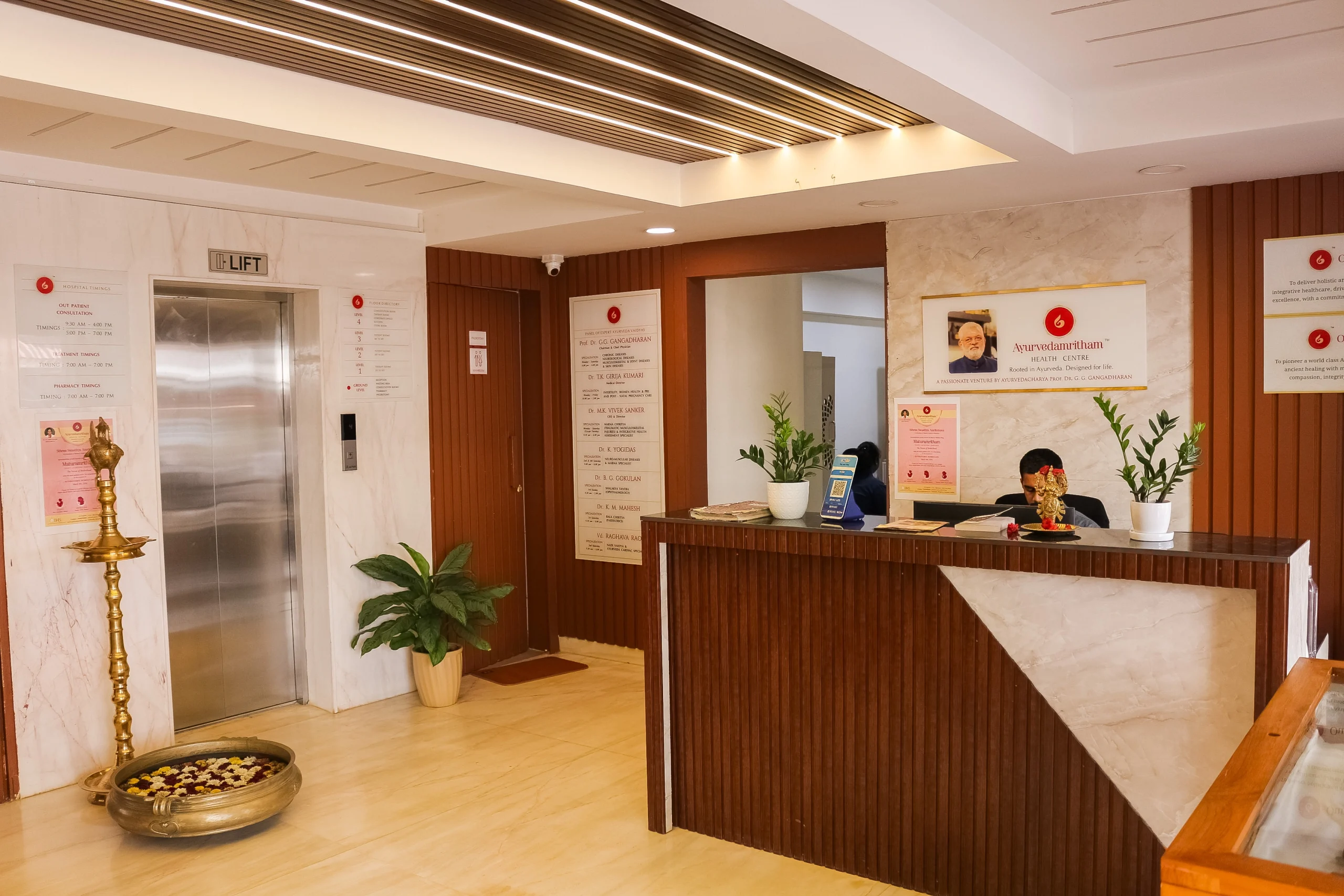
Ayurvedamritham Health Centre is led by Prof. Dr. G. G. Gangadharan, one of India’s senior Ayurveda physicians, with more than four decades in clinical practice, teaching and research. Joint care here follows classical Vata management — oleation, fomentation and Basti in sequence — rather than a fixed number of massage sittings sold as a package.
Ayurveda treatment for Ostearthritis: Frequently Asked Questions
Start with an assessment, not a prescription
Bring any X-rays or MRI reports, your current painkillers, and a note of what you can and cannot do now — stairs, walking distance, floor sitting. That functional picture matters more than the scan.