
Joint Disorders / Amavata
Ayurveda Treatment for Rheumatoid Arthritis
Rheumatoid arthritis begins in the gut, not the joints. Ayurveda has said so for two thousand years — and the treatment sequence that follows from it is very different from what most joint pain receives.
40+ years
Led by Prof. Dr. G. G. Gangadharan
Yelahanka
North Bengaluru, Judicial Layout
Alongside
Your rheumatologist, not instead of
What is rheumatoid arthritis?

Rheumatoid arthritis is an autoimmune disease in which the body’s own immune system attacks the lining of the joints. The result is pain, swelling and heat in multiple joints at once, usually on both sides of the body, and usually starting in the small joints of the hands and feet.
Its signature is morning stiffness — an hour or more of hands that will not close, easing slowly as the day goes on. Alongside the joints come the systemic features that patients often mention only when asked: exhaustion that sleep does not fix, low-grade fever, poor appetite, a general heaviness in the body.
Left unchecked, the inflammation erodes joint surfaces and deforms them permanently. That is why the timing of treatment matters more here than in almost any other joint condition.
Treatment for rheumatoid arthritis in Ayurveda begins with Amavata
The name contains the whole theory. Ama [undigested metabolic residue] plus Vata [the principle of movement] — a toxin generated by faulty digestion, carried by Vata, and deposited in the joints.
How it forms
Samprapti
Weak Agni [digestive fire] leaves food incompletely processed. The residue turns sticky and reactive. Vata picks it up, carries it through the channels, and lodges it in shleshaka Kapha — the lubricating fluid of the joints. Inflammation follows.
The classical signs
Amavata lakshana
Sandhi shoola [joint pain] with stabdhata [stiffness], angamarda [body ache], aruchi [loss of appetite], gaurava [heaviness], jwara [fever] and alasya [lassitude]. Pain that migrates between joints is specifically described.
Why this is not treated like osteoarthritis. Osteoarthritis is a disease of depletion, and oil massage is given early to nourish a dry joint. Amavata is the opposite — a disease of accumulation and blockage. Applying oil to a joint still full of Ama is classically contraindicated: it seals the toxin in and the patient worsens. Ama must be digested first. Clinics that offer the same oil-massage package for all joint pain get this backwards, and it is the commonest reason patients tell us a previous course made them feel heavier.
What generates and sustains it
Classical causation for Amavata centres almost entirely on digestion and the habits that damage it.
What a course of treatment actually looks like
The order here is not negotiable. Digest the Ama, clear it out, then and only then nourish the joints. Durations below are typical — yours is set after assessment.
Assessment
Day 1
Joint pattern and symmetry, duration of morning stiffness, current DMARDs and steroids, RA factor and anti-CCP, inflammatory markers, and an assessment of whether Ama is still active.
Langhana & Deepana–Pachana
Days 1 – 10
Lightening therapy with pungent, bitter digestive herbs — Shunthi, Guduchi, Panchakola. No oil, internal or external, until the signs of Ama have cleared. This stage alone often reduces stiffness and heaviness markedly.
Rooksha Sweda
Days 7 – 14
Dry fomentation — Valuka Sweda [heated sand poultice] or Churna Pinda Sweda [herbal powder poultice] — rather than oil-based heat, because the joint is still congested rather than dry.
Shodhana
Days 14 – 26
Virechana [therapeutic purgation] to clear the digested Ama from the system, followed by Vaitarana Basti — a specialised medicated enema formulated for Amavata rather than the oil-rich Basti used in degenerative disease.
Snehana, at last
From week 4
Only once Ama is cleared do oleation therapies become appropriate, now safely nourishing joints that have been inflamed for years. Attempting this stage first is the classic error.
Shamana & Rasayana
Months 2 – 8
Long-phase internal medicines, a settled diet, and monthly review with periodic inflammatory-marker testing. Amavata is a relapsing disease; this phase is what keeps it quiet.
Medicines, Therapies and Daily care
Internal formulations
Chosen by stage — the medicines used while Ama is active differ entirely from those used afterwards:
- Rasnasaptaka Kashayam and Rasna Erandadi Kashayam
- Simhanada Guggulu, long regarded as the principal formulation for Amavata
- Panchakola Churna and Shunthi through the digestive phase
- Guduchi and Shallaki [Boswellia] for sustained immune and joint support
External therapies
Sequenced against the presence of Ama, never applied by default:
- Valuka Sweda and Churna Pinda Sweda — dry heat, used while Ama is active
- Upanaha [medicated poultice bandaged over the joint] for persistent swelling
- Vaitarana Basti, the Amavata-specific enema
- Abhyanga and Patra Pinda Sweda, introduced only in the later nourishing phase
Diet
Warm, light, freshly cooked food. Ginger, black pepper, long pepper and cumin used routinely. Out: curd, cold and leftover food, heavy fried items, excessive wheat and black gram. Meals at fixed times, and nothing eaten before the last meal has digested.
Movement & Rest
Complete rest stiffens the joints further; overexertion during a flare damages them. The plan sets gentle daily range-of-motion work, activity reduced during flares, and warmth kept on affected joints — damp cold reliably worsens Amavata.
Why Choose Ayurvedamritham
Integrative by design, not by compromise
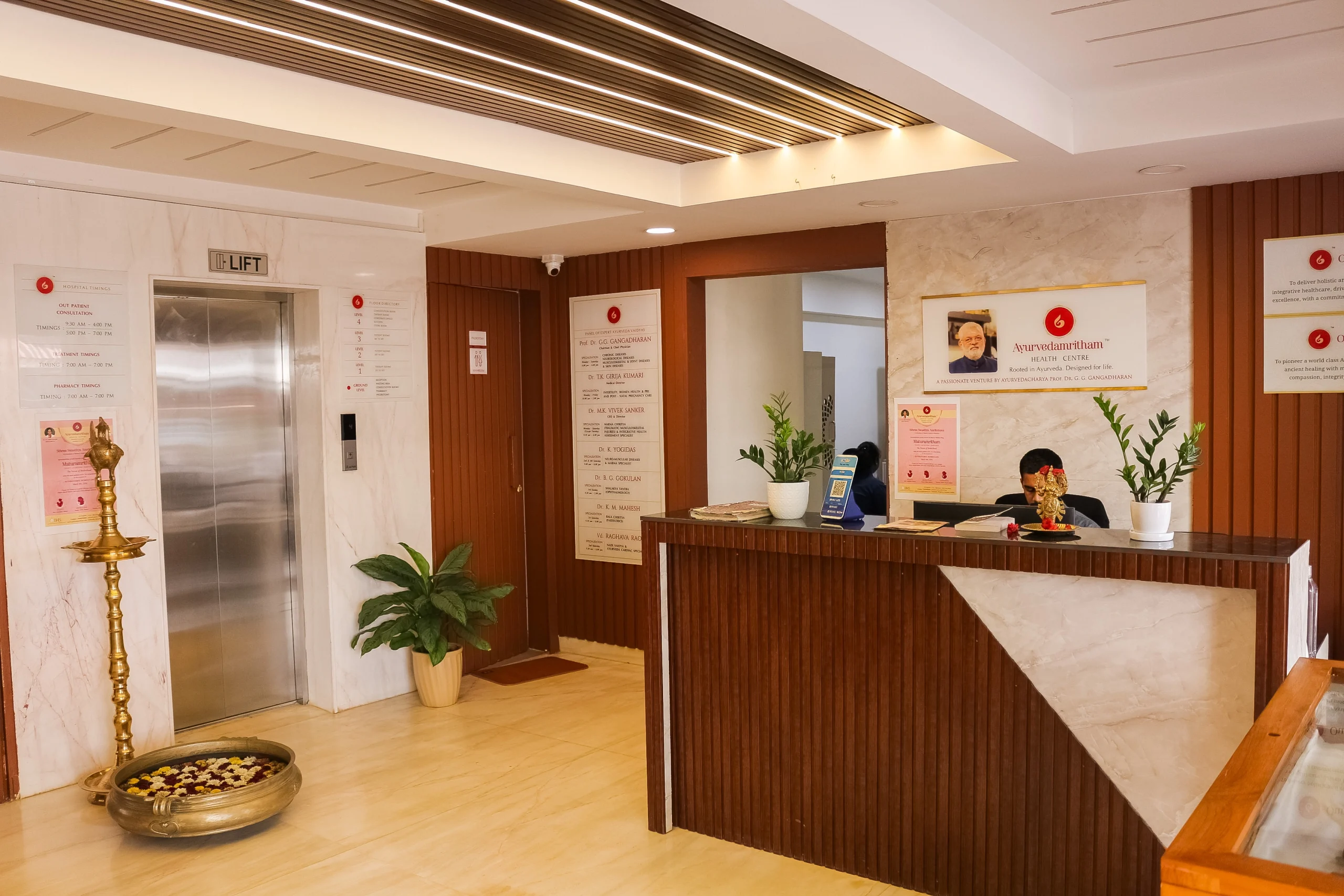
Ayurvedamritham Health Centre is led by Prof. Dr. G. G. Gangadharan, one of India’s senior Ayurveda physicians, with more than four decades in clinical practice, teaching and research. Rheumatoid arthritis is treated here alongside your rheumatologist’s care, not as a replacement for it.
Ayurveda treatment for rheumatoid arthritis: Frequently Asked Questions
Start with an assessment, not a prescription
Bring your rheumatology prescriptions, your most recent RA factor, anti-CCP, ESR and CRP reports, and any X-rays. Note how long your morning stiffness lasts — it is one of the most useful things you can tell us.