
Endocrine & Metabolic / Artava Kshaya
Ayurveda Treatment for PCOS
Irregular cycles, weight that will not shift, acne and unwanted hair are not four separate problems. Ayurveda treats the single metabolic disturbance underneath them.
40+ years
Led by Prof. Dr. G. G. Gangadharan
Yelahanka
North Bengaluru, Judicial Layout
Whole-cycle
Metabolic, hormonal and menstrual
What PCOS actually is

Polycystic ovary syndrome is a hormonal and metabolic condition affecting a large share of women of reproductive age in India. The follicles in the ovary begin developing but do not mature and release; they remain as small fluid-filled sacs, and ovulation becomes irregular or stops.
What patients actually notice is broader: cycles that arrive every forty-five days, or every ninety, or unpredictably. Weight that accumulates around the middle and resists every diet. Acne along the jaw. Hair thinning on the head while appearing on the chin. And often, difficulty conceiving.
Underneath most of it sits insulin resistance — which is why PCOS is as much a metabolic condition as a gynaecological one, and why treating the ovary alone rarely holds.
Treatment for PCOS/PCOD in Ayurveda begins with the channels
Ayurveda has no single term for PCOS. It describes the presentation across several classical conditions, and the overlap between them is what makes the picture clear.
Artava Kshaya
Diminished menstrual flow
Delayed, scanty or absent cycles arising when artavavaha srotas [the channels governing menstruation] are obstructed.
Medoroga
Disordered fat metabolism
Excess meda dhatu [fat tissue] with weak Agni, producing the central weight gain and insulin resistance.
Granthi
Nodular formation
The Kapha-dominant tendency to form encapsulated swellings — the classical reading of the follicular cysts themselves.
The mechanism the texts describe runs in a single line: weak Agni [digestive fire] leads to excess meda, excess meda obstructs the channels, and obstruction prevents Vata from performing its one essential job in the cycle — moving things downward and outward at the right moment. Kapha blocks; Vata cannot push; the cycle fails.
This is why treatment works on metabolism first and the cycle second. Restore digestion and clear the obstruction, and the menstrual rhythm usually follows on its own.
An honest note on what Ayurveda claims. PCOS is a chronic condition with a genetic basis. Treatment can regularise cycles, reduce weight and insulin resistance, improve acne and hair pattern, and materially improve the chance of conception — but it is managed rather than cured, and the results hold only as long as diet and activity hold. Any clinic promising permanent cure in a fixed number of weeks is not describing this condition accurately.
What drives it?
PCOS has a genetic component. What determines how severely it expresses is mostly modifiable.
What a course of treatment actually looks like
Clear the obstruction, correct the metabolism, then restore the cycle. Therapy timing is coordinated with your menstrual dates. Durations below are typical — yours is set after assessment.
Assessment
Day 1
Cycle history, weight pattern, acne and hair distribution, ultrasound findings, hormone panel, fasting insulin and glucose, thyroid, and any hormonal medication you are already on.
Deepana & Pachana
Days 1 – 10
Digestive and metabolic correction with bitter and pungent herbs. The diet shift starts here too — this stage is where insulin resistance begins to move, and everything downstream depends on it.
Udwartana & Swedana
Days 5 – 20
Dry herbal powder massage against the direction of hair growth, followed by herbal steam. Used daily to act on meda dhatu, improve circulation and mobilise the Kapha obstruction.
Shodhana
Days 14 – 26
Vamana [therapeutic emesis] where Kapha clearly dominates — heavy build, marked insulin resistance. Virechana [therapeutic purgation] where acne, heat and hair growth are prominent. Chosen by presentation, not by protocol.
Uttara Basti
Cycle-Timed
Where indicated, a specialised medicated instillation acting directly on artavavaha srotas. Timed to a specific window in the cycle, and used particularly where conception is the goal.
Shamana & cycle tracking
Months 2 – 6
Internal medicines, sustained diet and movement, with cycles tracked month by month. Three to six cycles is the realistic window for judging whether rhythm has been restored.
Medicines, Therapies and Daily care
Internal formulations
Selected by whether obstruction, metabolism or cycle failure dominates the picture:
- Kanchanara Guggulu, the principal formulation for granthi
- Varanadi Kashayam for Kapha-medo obstruction
- Chandraprabha Vati and Triphala for metabolic support
- Shatavari, Ashokarishta and Dashamoolarishta for cycle regulation
Therapies
Chosen for their metabolic action rather than for relaxation:
- Udwartana — the central external therapy in PCOS
- Vamana or Virechana for systemic clearing
- Uttara Basti and Yoga Basti where fertility is the goal
- Shirodhara where stress is clearly driving the cycle disturbance
Movement and sleep
Resistance work matters more than long cardio for insulin sensitivity. Sleep before eleven, no day sleep, and a genuine plan for stress — cortisol drives this condition more than most patients are told.
Diet
The intervention that decides whether anything else holds. Refined carbohydrate and sugar reduced sharply, protein raised, meals kept to fixed times with no grazing between, and the largest meal taken at midday when digestion is strongest.
Why Choose Ayurvedamritham
Classical practice, in North Bengaluru
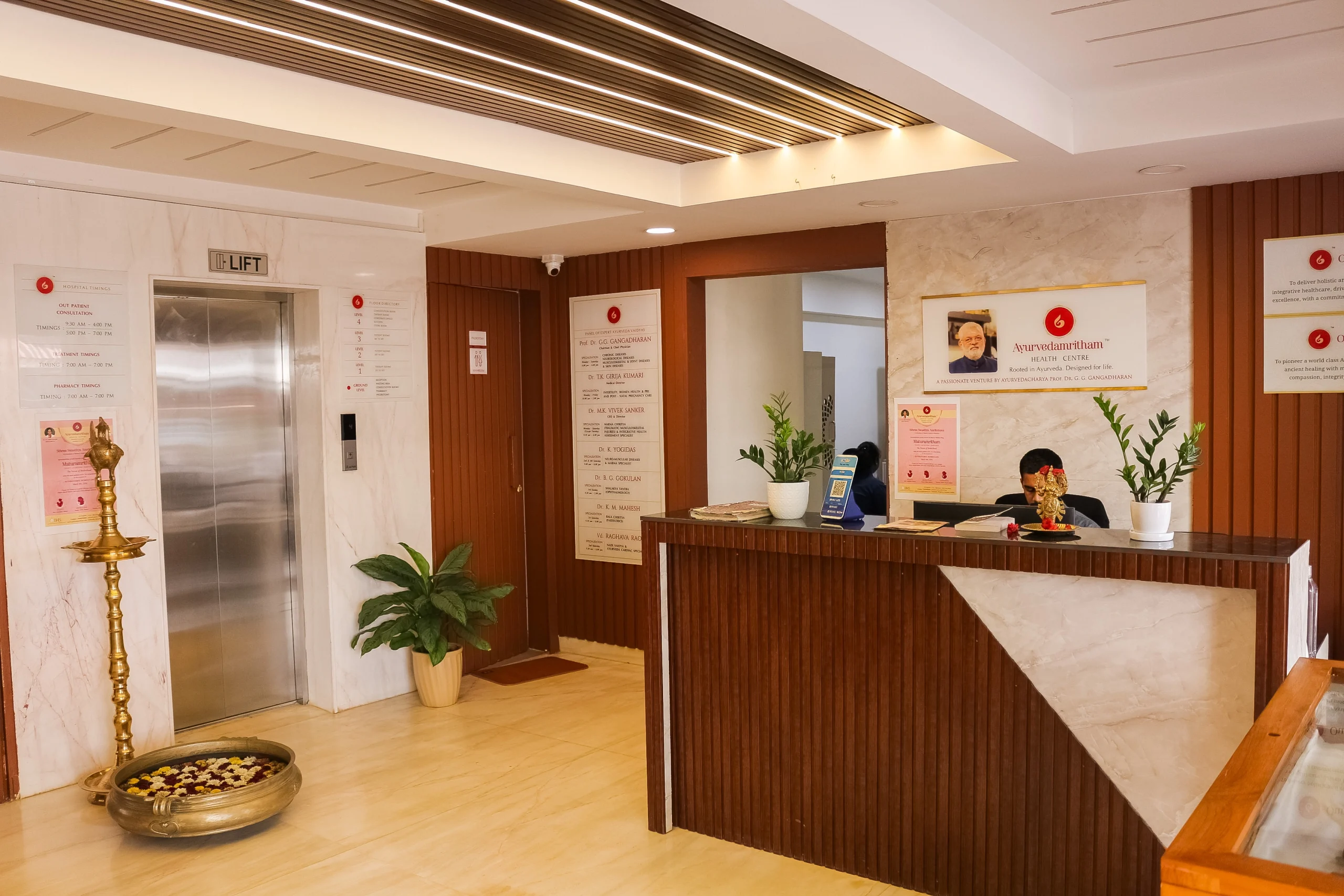
Ayurvedamritham Health Centre is led by Prof. Dr. G. G. Gangadharan, one of India’s senior Ayurveda physicians, with more than four decades in clinical practice, teaching and research. PCOS is treated here as a metabolic condition with gynaecological consequences — which changes what the treatment prioritises.
If you are approaching or past menopause, our Maturamritham programme addresses that transition specifically.
Ayurveda Treatment for PCOS: Frequently Asked Questions
Start with an assessment, not a prescription
Bring your ultrasound report, hormone and thyroid panels, fasting insulin if you have it, and a record of your last six cycle dates. That cycle record tells us more than any single scan.