
Skin Ailments / Kitibha
Ayurveda Treatment for Psoriasis
Psoriasis is not a surface problem. Ayurveda treats it as a deep disturbance in digestion, blood and immunity — and works at that level, without steroids or immunosuppressants.
40+ years
Led by Prof. Dr. G. G. Gangadharan
Yelahanka
North Bengaluru, Judicial Layout
Classical
Panchakarma to Charaka protocol
What psoriasis actually is
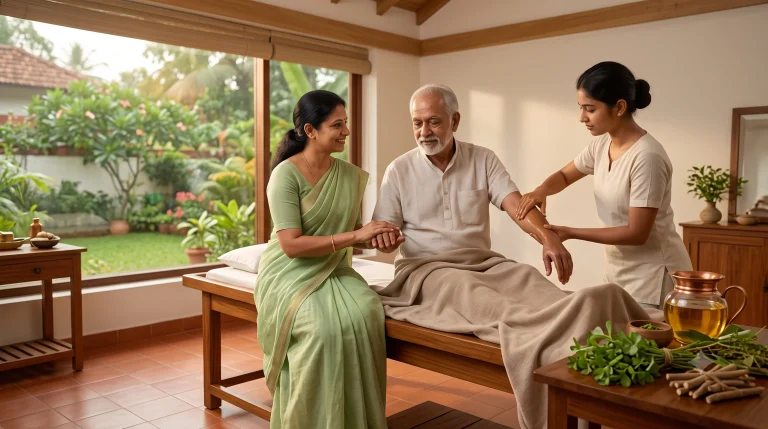
Psoriasis is a long-term autoimmune condition in which skin cells multiply far faster than the body can shed them. The result is the familiar pattern: raised plaques, silvery scaling, redness, cracking, and an itch that interferes with sleep.
Most people arrive here after years of the same cycle. A steroid cream clears the patch. The patch returns, often larger. The next prescription is stronger. Somewhere in that cycle the skin thins, the relief shortens, and the question changes from how do I clear this to why does it keep coming back.
That second question is where Ayurveda begins.
Treatment for psoriasis in Ayurveda begins with Kitibha
Ayurveda groups skin disease under Kushtha [the classical category covering chronic skin disorders]. Within it, psoriasis maps most closely to two descriptions.
Kitibha
Kitibha Kushtha
Described in the classical texts as lesions that are shyava [dark, brownish-grey] and khara [rough and hard to the touch, like a callus]. Driven principally by Vata and Kapha.
Ekakushtha
Ekakushtha
Characterised by aswedana [absent sweating over the patch], spread across a wide area, with scaling compared in the texts to fish scales. This is the closest classical match to plaque psoriasis.
Both sit within the eleven Kshudra Kushtha [minor skin disorders] catalogued by Charaka. But the classification matters less than what it implies about mechanism. Every form of Kushtha, the texts insist, involves seven factors at once: all three doshas, plus four affected tissues — twak [skin], rakta [blood], mamsa [muscle] and ambu [the body’s water and lymph].
That is why treating the skin alone fails. The visible plaque is the last link in a chain that starts in the gut.
Weak Agni
When Agni [digestive fire] falters, food is incompletely processed and Ama [metabolic toxins] forms.
Blood carries it outward
Ama enters the bloodstream and corrupts rakta dhatu [the blood tissue], carrying the disturbance outward.Ama in circulation
Skin as the outlet
The body pushes the disturbance to its outermost tissue. The plaque is the exit point, not the origin.
What sets it off
Charaka is unusually direct about the causes of Kushtha, and the list has aged well. Most of it describes an ordinary week in a Bengaluru software job.
An honest note on what Ayurveda claims. Charaka classifies Kushtha as krichchhrasadhya [difficult to treat] and, in advanced stages, yapya [manageable rather than curable]. We hold to that. Our aim is long remission, fewer and milder flares, and freedom from steroid dependence — not a guaranteed permanent cure. Any clinic promising one is not quoting the texts.
Our Ayurveda Treatment Protocol
Classical psoriasis management is sequenced, not simultaneous. Purification precedes nourishment; skip a stage and the next one does not hold. Durations below are typical — yours is set after assessment.
Assessment
Day 1
Constitution, dosha dominance, lesion mapping, digestive history, current medication and existing blood work are reviewed together before anything is prescribed.
Deepana & Pachana
Days 1 – 7
Bitter and digestive herbs restore Agni and begin breaking down accumulated Ama. Purification attempted before this stage is unsafe and ineffective.
Snehapana
Days 5 – 12
Medicated ghee — commonly Mahatiktaka Ghrita or Tiktaka Ghrita — taken internally in a rising daily dose, drawing the disturbance out of deep tissue and back toward the gut.
Shodhana
Days 12 – 21
The main purification, chosen by dominant dosha: Virechana [therapeutic purgation] for Pitta-led presentations, Vamana [therapeutic emesis] where Kapha leads, and Raktamokshana [bloodletting] used selectively for localised, stubborn plaques.
Samsarjana Krama
Days 21 – 28
A graded rebuilding of diet from thin gruel back to normal food. Rushing this stage is the commonest reason a good purification fails to hold.
Shamana & Rasayana
Months 2 – 6
The long phase. Blood-purifying decoctions, Rasayana [rejuvenative] formulations and a settled diet, reviewed monthly. This is where remission is won or lost.
Medicines, Therapies and Daily care
Internal formulations
Selected by presentation, not by diagnosis alone. Commonly used at this centre:
- Aragwadhadi Kashayam and Manjishtadi Kashayam — decoctions that act on rakta dhatu
- Patolakaturohinyadi Kashayam for itching with heat
- Panchatikta Ghrita Guggulu and Arogyavardhini Vati
- Khadirarishta as a long-phase blood purifier
External applications
Topical care runs alongside internal treatment, never instead of it:
- Nalpamaradi Tailam and Eladi Tailam for scaling and discolouration
- Herbal lepa [medicated paste] made to the individual lesion pattern
- Panchavalkala decoction wash for weeping or cracked plaques
- Takradhara [medicated buttermilk poured over the forehead] where flares track clearly with stress
Stress and Sleep
Psoriasis flares track stress closely enough that the texts name grief and disturbed sleep among the causes. Treatment includes a workable sleep routine, breathing practice, and Shirodhara or Takradhara where indicated.
Diet
The single largest determinant of whether remission holds. We remove incompatible combinations first — curd at night, fish with milk, excess sour and fermented food — then build a plan around your constitution rather than a printed handout.
Why Choose Ayurvedamritham
Classical practice, in North Bengaluru
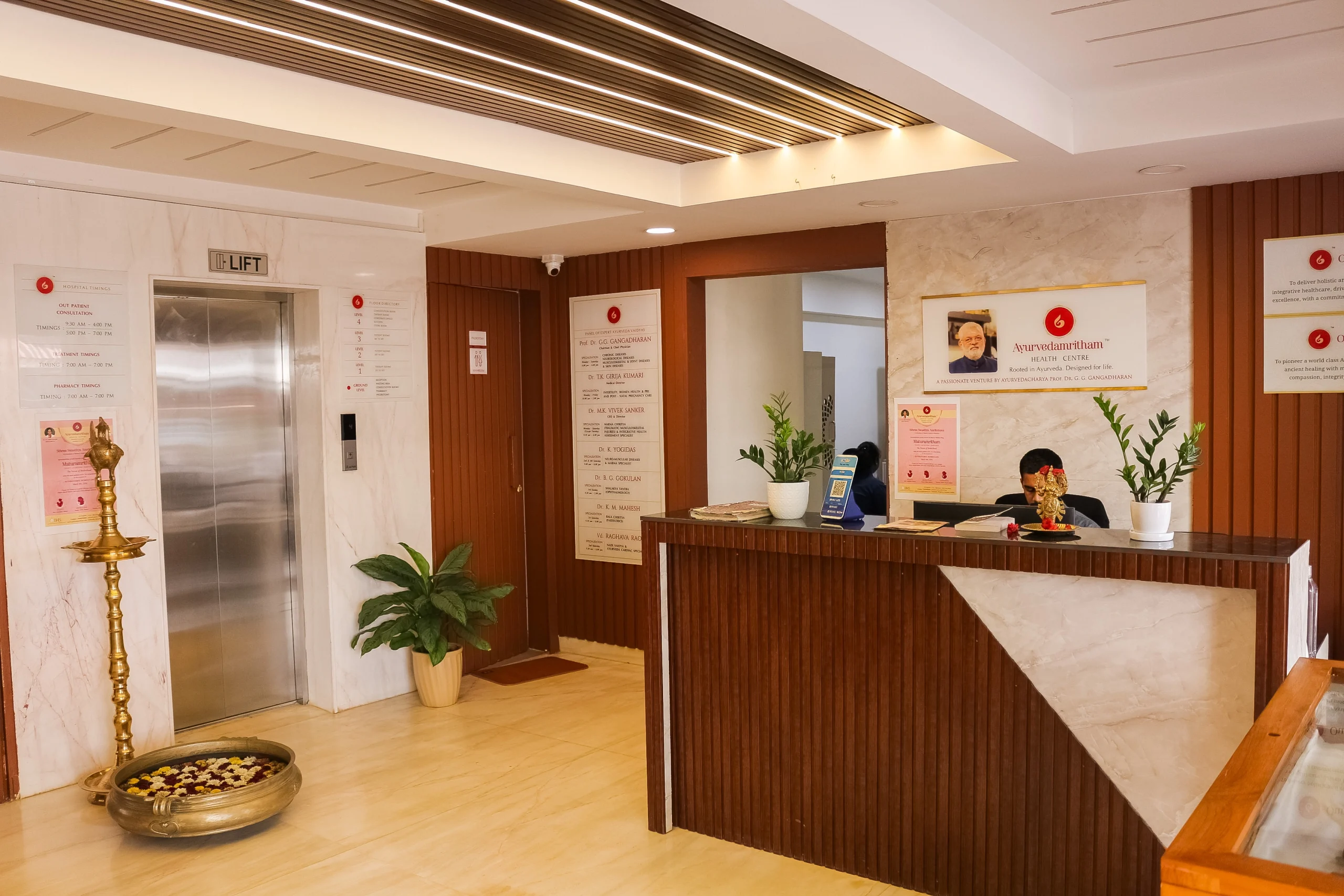
Ayurvedamritham Health Centre is led by Prof. Dr. G. G. Gangadharan, one of India’s senior Ayurveda physicians, with more than four decades in clinical practice, teaching and research. Psoriasis care here follows classical staging — assessment, purification, rebuilding, rejuvenation — rather than a fixed package sold by the day.
Ayurveda Treatment for Psoriasis: Frequently Asked Questions
Start with an assessment, not a prescription
Bring your current medicines, any recent blood work, and a rough history of when the flares began. The first consultation is about understanding the pattern — treatment is planned after that.